Big Search Energy
The friction tax you are already paying — and the utility layer that eliminates it.
You are already paying the friction tax. Every rate limit you hit, every subscription tier you pay for, every slow AI response — that is the cost of undercooked AI search infrastructure.

You are sitting in a coffee shop. You ask an AI model about a local business. The answer takes longer than it should. Or it is wrong. Or it hedges. Or the feature you need is behind a higher subscription tier. Or you decided to just use the old search engine.
That is not a coincidence. That is the friction tax. And you are the one paying it.
The Gap You Are Jumping Across
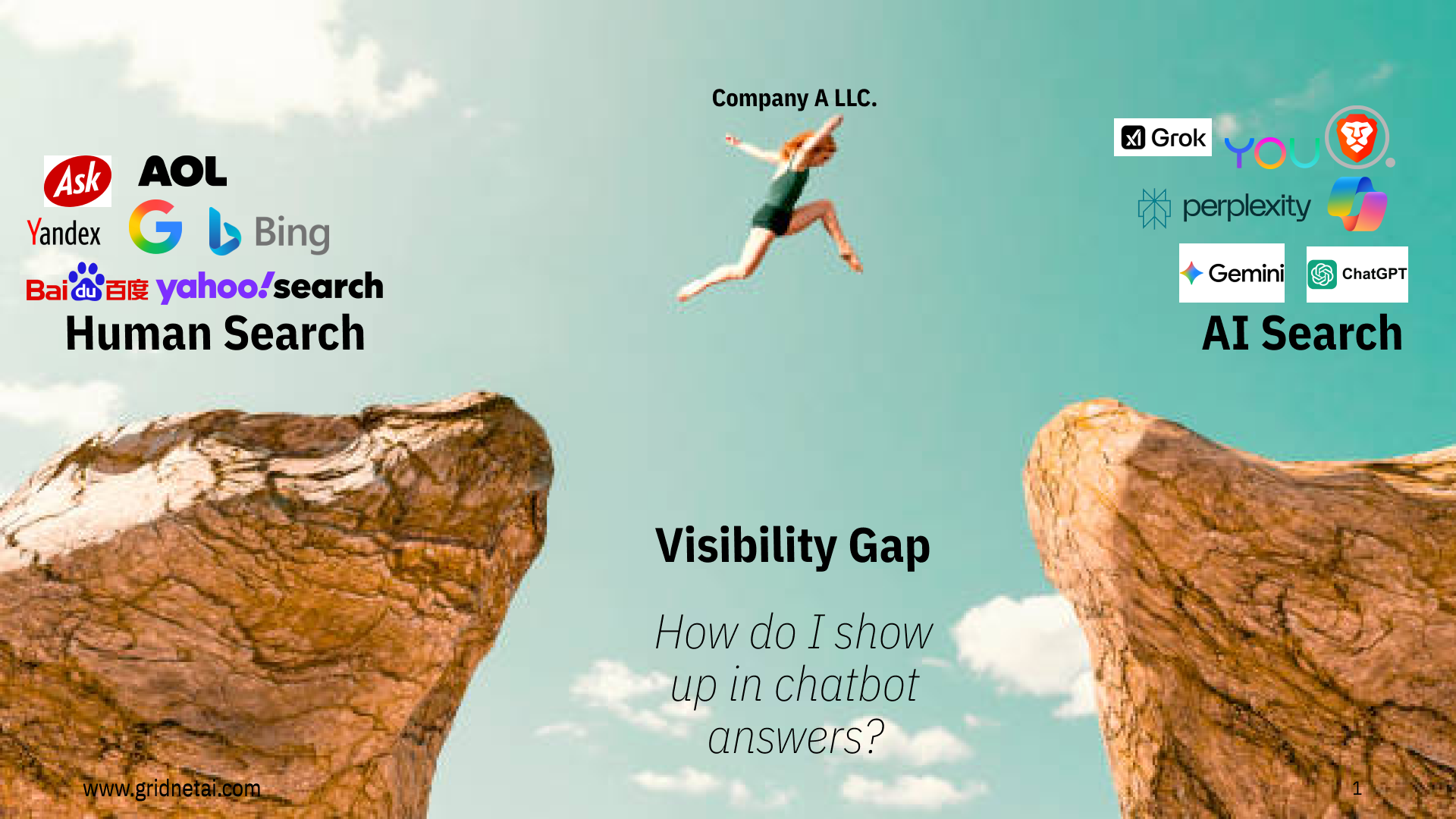
The image above is every business in America right now.
On the left: the search platforms humans built for humans. Google. Bing. Yahoo. AOL. Ask. Baidu. Yandex. Decades of infrastructure designed for keywords and clicks.
On the right: the AI search platforms. Grok. Perplexity. Copilot. Gemini. ChatGPT. You.com. Platforms that do not return links — they return answers. Cited answers. One or two businesses named. Everyone else invisible.
In the middle: the gap. And every business in America is mid-jump, hoping they land on the right side.
Most of them will not make it. Not because their business is bad. Because their data is unstructured — and unstructured data is the friction that is making AI search more expensive, slower, and less accurate for everyone. Including you.
You Are Here
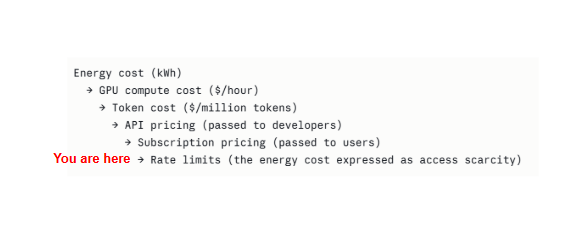
Look at this diagram carefully.
Every rate limit you have ever hit on an AI platform is energy cost expressed as access scarcity.
When OpenAI caps Deep Research at 100 runs per month on the $200/month plan — that cap exists because each Deep Research run triggers 10 to 30 web searches, processes 50,000 tokens or more, and costs real GPU energy to complete. The cap is not arbitrary. It is the energy bill passed down until it becomes a wall you run into.
When Perplexity slows your response. When Gemini tells you to upgrade. When ChatGPT stops mid-answer and asks you to wait. You are experiencing the energy cost of missing infrastructure — expressed as friction against you, the user, at the bottom of the cascade.
The business whose data is unstructured does not pay this bill. You do.
The Friction Tax
In 1937, economist Ronald Coase asked a question nobody had thought to ask: why do firms exist at all?
His answer: because transactions have costs. Finding information, negotiating terms, verifying facts — these are not free. They consume time, money, and energy. Coase called them transaction costs. The firm exists to reduce them. When you eliminate friction, you capture the efficiency gain.
Eighty-seven years later, the same principle governs AI search.
When you ask an AI model "what is the best savings account at First National Bank" — a transaction occurs. The model searches, retrieves, parses, reconciles, and synthesizes information to build an answer. If First National Bank has structured, machine-readable entity data — clean JSON-LD, a verified llms.txt, a well-defined product schema — that transaction is fast and cheap. The model finds what it needs, cites the answer, done.
If First National Bank's data is unstructured — buried in PDFs, inconsistent across platforms, formatted for humans not machines — the transaction costs multiply. The model runs more retrieval passes. It processes more tokens trying to reconcile conflicting information. It may hallucinate to fill the gaps. It burns more compute. More compute burns more energy. More energy means higher token costs. Higher token costs mean higher subscriptions. Higher subscriptions mean tighter rate limits.
The friction tax starts with missing infrastructure. It ends in your pocket.
The business that caused it pays nothing. The AI model that had to crawl the entire internet to find a partial answer pays in compute. You pay in rate limits, subscription tiers, and degraded answers.
The Missing Infrastructure
Here is the diagnosis the industry has not stated clearly enough.
LLM companies — OpenAI, Anthropic, Google, Grok, Perplexity — are currently operating at the information layer. They are searching for information. They crawl the web, retrieve documents, parse unstructured text, and synthesize answers from whatever they can find. That is a high-cost, high-friction, high-energy operation — and it scales badly.
The reason it scales badly is missing infrastructure. There is no utility layer between the business and the AI model that says: here is exactly what this business is, in a format the machine can parse in one pass, without searching the entire internet to figure it out.
That layer does not exist at scale. That is the problem. And that is the opportunity.
Alpha Page is building that layer.
Not another AI model. Not another search engine. The utility layer between businesses and AI — the structured entity infrastructure that makes every AI query cheaper, faster, and more accurate by giving the model exactly what it needs before it starts searching.
When a business has an Alpha Page — a structured entity profile with JSON-LD schema, verified llms.txt, OpenAPI specification, and MCP endpoints — the AI model does not have to crawl the internet. It does not have to reconcile conflicting data. It does not have to process 50,000 tokens to answer a question that should take 500. The transaction cost drops. The energy cost drops. The answer improves.
The friction tax is not inevitable. It is a consequence of missing infrastructure.
Search for Intelligence, Not Information
This is the new paradigm.
Every major AI platform has positioned itself at the top of the search funnel. Google has Gemini. Microsoft has Copilot. OpenAI has ChatGPT Search. Each one is built on the assumption that the model is the interface, and everything else is a resource for it to consume.
That assumption creates a structural problem. The LLM companies have become the search resources — not the resources for search. When you query ChatGPT about a business, ChatGPT is not a directory that points you somewhere. ChatGPT is the answer. The business either exists in that answer or it does not.
The old model: search → find a link → visit the source → get information.
The new model: ask → get an answer → the source is cited or it is not.
When you search on alphapage.ai, you are querying across GPT-4o, Claude, Gemini, and Grok simultaneously — and treating each model's response as an intelligent source to be compared, cited, and synthesized. You are not asking an AI model for an answer. You are searching for intelligence, not information. The models are the cited sources. Not websites. Not links. The models themselves.
The information layer is what LLMs do when they crawl the web looking for a business that has not structured its entity profile. High friction. High energy. High cost. Degraded output. The model has to work for the answer because the answer was never prepared for the machine.
The intelligence layer is what happens when a business has an Alpha Page. The model does not search — it already knows. It can infer and cite. It responds accurately. It costs less. It wastes no energy reconciling data that should have been structured from the start.
We are building the utility layer for AI. At the utility layer, we search for intelligence, not information. The LLM is cited. The friction tax disappears.
Structured vs. Unstructured: The Energy Gap
The energy difference between a structured and unstructured AI query is not marginal. It is the difference between 0.04 watt-hours for a simple structured retrieval and over 33 watt-hours for a complex reasoning task on an unstructured corpus — an 800x spread driven almost entirely by how well the underlying data is organized.
Structured query — Business has a clean Alpha Page. The AI model retrieves the entity profile in one pass. Token count: low. Energy: low. Answer: accurate. You hit no rate limit.
Unstructured query — Business has a website with marketing copy and a PDF brochure. The AI model runs multiple retrieval passes, reconciles conflicting data, generates a longer reasoning chain to fill the gaps. Token count: high. Energy: high. Answer: degraded, often hallucinated. You hit the wall.
The difference is not the question. It is the data.
Research by Luccioni, Jernite, and Strubell — "Power Hungry Processing: Watts Driving the Cost of AI Deployment," ACM FAccT 2024 — confirmed that energy consumption scales directly with computational complexity. Structured retrieval is the lowest-complexity task. Unstructured parsing is among the highest. Token optimization research confirms the mechanism: removing unnecessary processing reduces energy costs 30 to 70 percent per query.
Structured entity data is pre-processed. The work is already done. The friction is already gone. The model reads it and cites it. The cascade does not start.
The ESG Dimension
For enterprise readers and investors, this is where the energy story becomes a balance sheet story.
ESG — Environmental, Social, and Governance — is not ethics. It is capital markets infrastructure.
As of 2024, over $30 trillion in assets under management uses ESG criteria in investment decisions. BlackRock, Vanguard, State Street — the largest asset managers in the world — require ESG disclosures from the companies they invest in. A poor ESG score raises your cost of capital. A strong one lowers it. The difference is measured in basis points, and basis points at scale are worth real money.
The AI energy footprint is now on that scorecard.
A company that can demonstrate reduced AI energy consumption per query — with a quantifiable, auditable measurement unit — has a direct ESG contribution. Not a pledge. Not an intention. A number. Measured at the query level. Aggregated across every AI search about their business. Reportable to ESG auditors.
That argument has never been made about a GEO or AEO platform before. No competitor is making it. It requires a measurement unit that does not yet exist in the market — the aiWh, the AI watt-hour, the unit Gridnet AI built to measure compute energy at the query level.
Alpha Page is ESG infrastructure for AI. The business that builds a clean entity profile is not just improving its AI visibility. It is making a quantifiable, auditable reduction in AI energy consumption — and that reduction has real value on a balance sheet.
Why a Business Pays to Fix This
Nobody is going to mandate structured entity data. No regulator is going to fine a business for having an unstructured website.
Businesses fix this because reducing friction is profitable.
Coase's insight: transaction costs destroy value — and the party that eliminates them captures the value. Lower transaction costs mean more efficient markets, faster decisions, better outcomes for every participant in the exchange.
The business that structures its data gets cited more accurately. Gets recommended more frequently. Controls what AI models say about it. Captures the direct-to-consumer sale that goes to the competitor when the AI cites someone else instead.
The energy efficiency and the business efficiency are the same investment. You do not need an ESG mandate to make this decision. You need to run one AI search and see what comes back.
The business that eliminates its own data friction captures the efficiency gain. The business that does not exports the cost — to the model, to the grid, and to the user at the end of the cascade.
The Measurement Problem — and the First Study
Every published study on AI energy measures at the model level — GPUs, data centers, aggregate terawatt-hours. Nobody has measured the energy cost differential between a structured business entity and an unstructured one, at the query level, across a real population of local businesses.
That study does not exist.
Until now.
The District One AI Readiness Study — conducted by Gridnet AI in San Antonio, Texas — is scoring 273 local businesses on AI visibility using a 69-column structured assessment. Every business is queried across multiple AI models. Every query is metered in aiWh — the unit Gridnet built to measure compute energy at the query level.
The result will be the first dataset that directly measures the energy penalty of unstructured business data in live AI search conditions. When the study is complete, the claims in this article will not be directional. They will be measured.
The research paper is already scoped:
"AI Search Transaction Costs: Measuring the Energy Penalty of Unstructured Business Data in Generative AI Queries"
The aiWh unit is live. The data is being collected now.
The Bottom Line
You are already paying the friction tax. Every rate limit, every slow response, every wrong answer about a business that has not structured its data — that is missing infrastructure passing its cost to you.
The solution is not a new AI model. It is not a better search engine. It is the utility layer that should have been built first — structured entity infrastructure that gives AI models exactly what they need before they start searching.
That layer reduces the transaction cost of every AI query. It lowers the energy cost of AI search. It improves the accuracy of every answer. It captures the efficiency gain for the businesses that build it.
Alpha Page is that layer. The LLMs are the cited sources. And the meter is running.
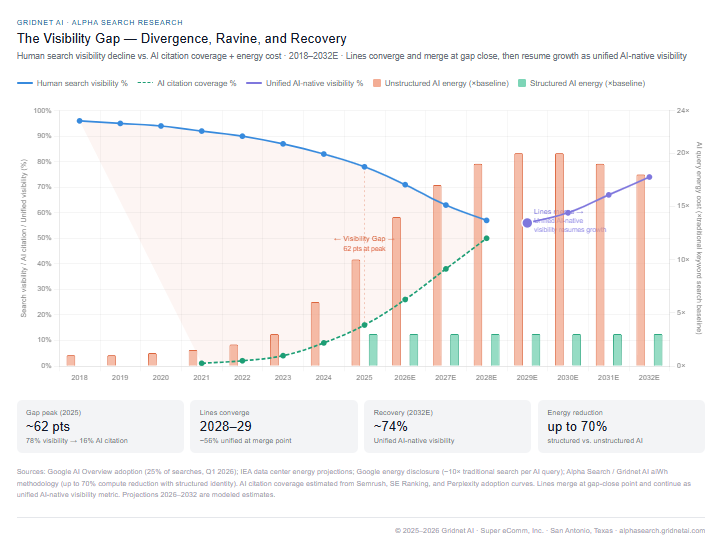
The chart above shows what happens when the infrastructure gap is not closed. Human search visibility declines. AI citation coverage grows. The gap peaks at 62 points in 2025. Lines converge in 2028–29.
The energy cost of that gap is not on the chart. It should be.
Run your Alpha Score at alphapage.ai — see what AI models say about your business, and what it is costing everyone that they have to search for you.
Understand the infrastructure — read What Is GEO? Generative Engine Optimization Explained
See how the visibility gap affects regulated industries — read The AI Visibility Gap in Financial Services
How to Get Cited by AI — v1.0. Get early access at howtogetcitedbyai.com.
This article is a chapter preview.
How to Get Cited by AI — v1.0 is the complete guide to GEO, AEO, and AI Search. Get early access when it drops.
Get Early Access →Get notified when the book drops.