What Is GEO? Generative Engine Optimization Explained
The new discipline that replaced SEO — without jargon.
Definition
GEO (Generative Engine Optimization) is the practice of structuring business data so AI models can find, understand, and cite it in generated answers.
Something changed in 2024.
Not slowly. Not gradually. Overnight.
People stopped typing keywords into Google and started asking questions out loud — to ChatGPT, to Gemini, to Perplexity, to Claude. And those AI models answered. Directly. Without a list of ten blue links to click through.
That shift created a problem for every business on the planet.
If you built your visibility on Google rankings, you built it on a foundation that is no longer the only foundation that matters.
GEO is the answer to that problem.
What GEO Stands For
GEO stands for Generative Engine Optimization.
A generative engine is an AI model that generates answers — as opposed to a search engine that returns a list of links. ChatGPT is a generative engine. So is Gemini. So is Perplexity. So is Claude.
Generative Engine Optimization is the practice of structuring your business data so those AI models can find, understand, and cite you in their answers.
That is the whole definition. Everything else is detail.
How GEO Is Different From SEO
SEO — Search Engine Optimization — was built for a world where search meant a list of links. You optimized your website to rank as high as possible on that list. The goal was a click.
GEO is built for a world where search means a direct answer. You optimize your business data to be cited as the authoritative source in that answer. The goal is a citation.
Here is the critical difference:
With SEO, the user still had to click your link. They visited your page. Your website was the destination.
With GEO, the AI model reads your data and synthesizes an answer. The user may never visit your website at all. Your data is the source — but the AI is the destination.
This is what people mean when they say "zero-click search." The answer is delivered in the AI response itself. If you are not structured to be cited in that response, you are invisible — even if you rank #1 on Google.
GEO vs SEO vs AEO: The Key Differences
| SEO | GEO | AEO | |
|---|---|---|---|
| Goal | Rankings on a results page | Visibility in AI-generated answers | Citation as the authoritative source |
| Output | A ranked link | Structured data AI can read | An answer attribution |
| Metric | Traffic, click-through rate | AI visibility, citation rate | Share of voice in AI answers |
| User action | Clicks your link | May not click at all | No click — answer is delivered directly |
| Foundation | Keywords and backlinks | Machine-readable structured data | Verified entity data + authority signals |
SEO, GEO, and AEO are not competing disciplines. They are sequential layers. SEO built the web presence. GEO builds the machine-readable layer on top of it. AEO fine-tunes that layer for citation authority.
Why Most Businesses Are Invisible to AI
Here is the uncomfortable truth.
Most business websites were built for humans to read. Navigation menus. Marketing copy. Images. PDFs. Beautiful design.
AI models do not read websites the way humans do. They look for structured data — clean, machine-readable signals that tell them what a business is, what it does, what it sells, and why it is trustworthy.
If that structured data does not exist, the AI model does one of two things:
It skips your business entirely. Or it guesses — and gets it wrong.
Both outcomes are bad. The first means you do not exist. The second means you exist incorrectly.
This is the AI visibility gap. It is real, it is measurable, and it is widening every day that businesses wait to address it.
What Structured Data Actually Means
You have probably heard "structured data" and assumed it means something complicated. It does not.
Structured data is just information formatted in a way that machines can parse reliably.
But here is what most people miss: structured data is not one thing. It is a spectrum. At Alpha Page we call it the VCAP Spectrum — Visibility, Capability, Action, and Performance.
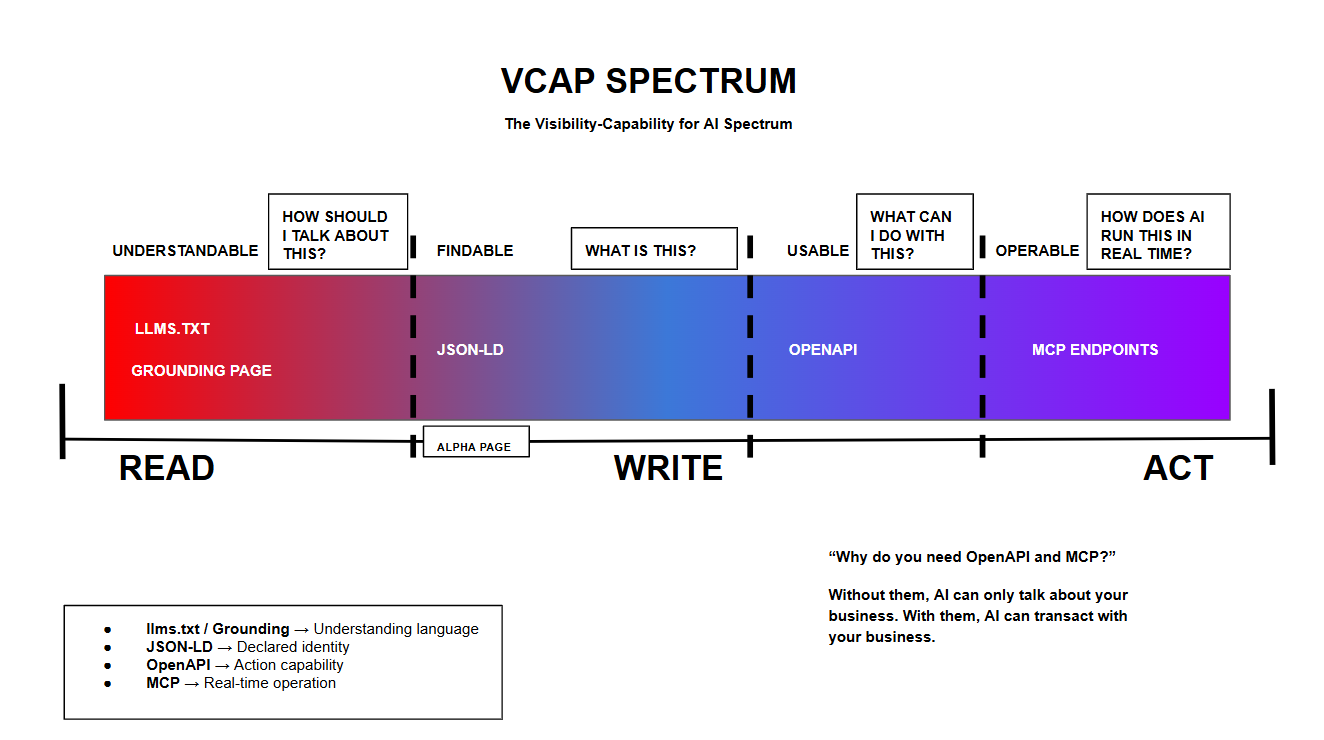
The spectrum runs from READ to WRITE to ACT. Each layer adds a new capability:
llms.txt and Grounding Pages sit at the READ end. They tell AI models how to talk about your business — your language, your tone, your context. This is understanding.
JSON-LD schema markup is the next layer. It declares your identity — your name, category, location, products, hours — in a vocabulary every AI model and search engine reads natively. This is findability.
OpenAPI Specification moves into WRITE territory. It tells AI agents what they can do with your business — query your inventory, check availability, retrieve product details. This is action capability.
MCP Endpoints — Model Context Protocol — are the ACT layer. They enable AI models to transact with your business in real time. Not just talk about you. Actually interact with your systems.
Most GEO tools stop at JSON-LD. Alpha Page covers the full spectrum — because the future of AI search is not just about being cited. It is about being operable.
The practical starting point for most businesses is llms.txt and JSON-LD. That alone puts you ahead of 95% of businesses. OpenAPI and MCP are the next layer — and the layer that matters most as AI agents become the primary way people interact with services.
What GEO Looks Like in Practice
A local restaurant that has done GEO right will appear when someone asks their AI assistant: "What is a good Italian restaurant near me with a private dining room?"
A financial services firm that has done GEO right will be cited when someone asks: "Which banks offer the best high-yield savings accounts?"
A law firm that has done GEO right will appear when someone asks: "What should I look for in a personal injury attorney?"
In every case, the AI model is not checking Google rankings. It is checking what it knows about the entity — and what it knows comes from structured data signals.
GEO is how you build those signals.
The Three Layers of GEO
Entity definition — making sure AI models know exactly who you are. Your name, category, location, founding, key people, products, and services — all structured in a way that disambiguates you from every other business with a similar name.
Authority signals — giving AI models reasons to trust you as a source. Citations from other sites. Consistent information across platforms. Schema markup that flags your expertise. The equivalent of backlinks in SEO — but for machine trust.
Citation optimization — structuring your content in a way that AI models can directly quote or summarize when answering questions in your category. This means writing for machines as well as humans: clear statements, defined terms, direct answers to the questions your customers ask.
How GEO Connects to AEO
GEO and AEO are the two layers of the machine profile for AI visibility. They are related but not the same.
GEO — Generative Engine Optimization is the broader practice. You are building the entire infrastructure of your AI visibility — both visibility and capability. Think of it as the foundation. AI agents need to be able to both read to understand your business and interact with it. GEO covers that full spectrum.
AEO — Answer Engine Optimization is the fine-tuning layer. Once your infrastructure is in place, AEO is about becoming the authoritative cited source when AI models answer direct questions in your category. You are optimizing both the visibility and capability content for things like updated information, compliance requirements, or building higher trust authority with specific AI models.
Both start with the same foundation: structured, machine-readable data that AI models can find and trust.
GEO builds the road. AEO makes sure your business is the destination at the end of it.
How to Measure Your GEO Performance
The Alpha Score is a 0–100 measure of how visible and citable your business is to AI models. It runs across six visibility sources and scores your structured data quality.
A score of 34 is common for a local business with a well-designed website but no structured data layer. A score of 72 means you are visible but have gaps. A score above 85 means AI models can find you, understand you, and cite you accurately.
Run your Alpha Score at alphapage.ai.
Frequently Asked Questions
What is GEO in simple terms? GEO is how businesses structure their data so AI models like ChatGPT, Gemini, and Perplexity can understand and cite them in generated answers.
What is the difference between GEO and SEO? SEO optimizes for ranked links on a search results page. GEO optimizes for direct citation in AI-generated answers. The mechanics, metrics, and technical requirements are different. GEO is not a replacement for SEO — it is the next layer on top of it.
What is the difference between GEO and AEO? GEO builds the foundation — the full infrastructure of AI visibility including structured data, entity definitions, and machine-readable signals. AEO is the fine-tuning layer that ensures your business is the one AI models choose to cite as the authoritative answer. GEO gets you into the room. AEO gets you to the front of it.
How do AI models decide who to cite? AI models weight structured data signals, entity clarity, authority indicators, content consistency, and YMYL compliance when deciding which sources to cite. Businesses with clean, verified, machine-readable entity profiles are cited more frequently and more accurately than those without.
Where do I start with GEO? Run a free AI search diagnostic at alphapage.ai/search. See how AI models currently describe your business. Then check your Alpha Score to understand where your structured data gaps are.
Learn what comes after GEO — read What Is AEO? Answer Engine Optimization Explained to understand how to become the authoritative cited source in AI-generated answers.
See how GEO applies to regulated industries — read The AI Visibility Gap in Financial Services for a deep dive into the highest-stakes category in AI search.
How to Get Cited by AI — v1.0 covers GEO, AEO, and AI Search in full. Get early access at howtogetcitedbyai.com.
This article is a chapter preview.
How to Get Cited by AI — v1.0 is the complete guide to GEO, AEO, and AI Search. Get early access when it drops.
Get Early Access →Get notified when the book drops.