Big Search Energy for Investors
Structured vs. unstructured — the 800x energy gap, the ESG contribution, and the infrastructure layer no competitor has built.
Structured vs. Unstructured: The 800x Energy Gap in AI Search
The difference between a structured and unstructured AI query is not 10 percent. It is not even 10 times. It is up to 800 times — and that gap is paid by every user, every subscriber, and every business that never fixed its data.
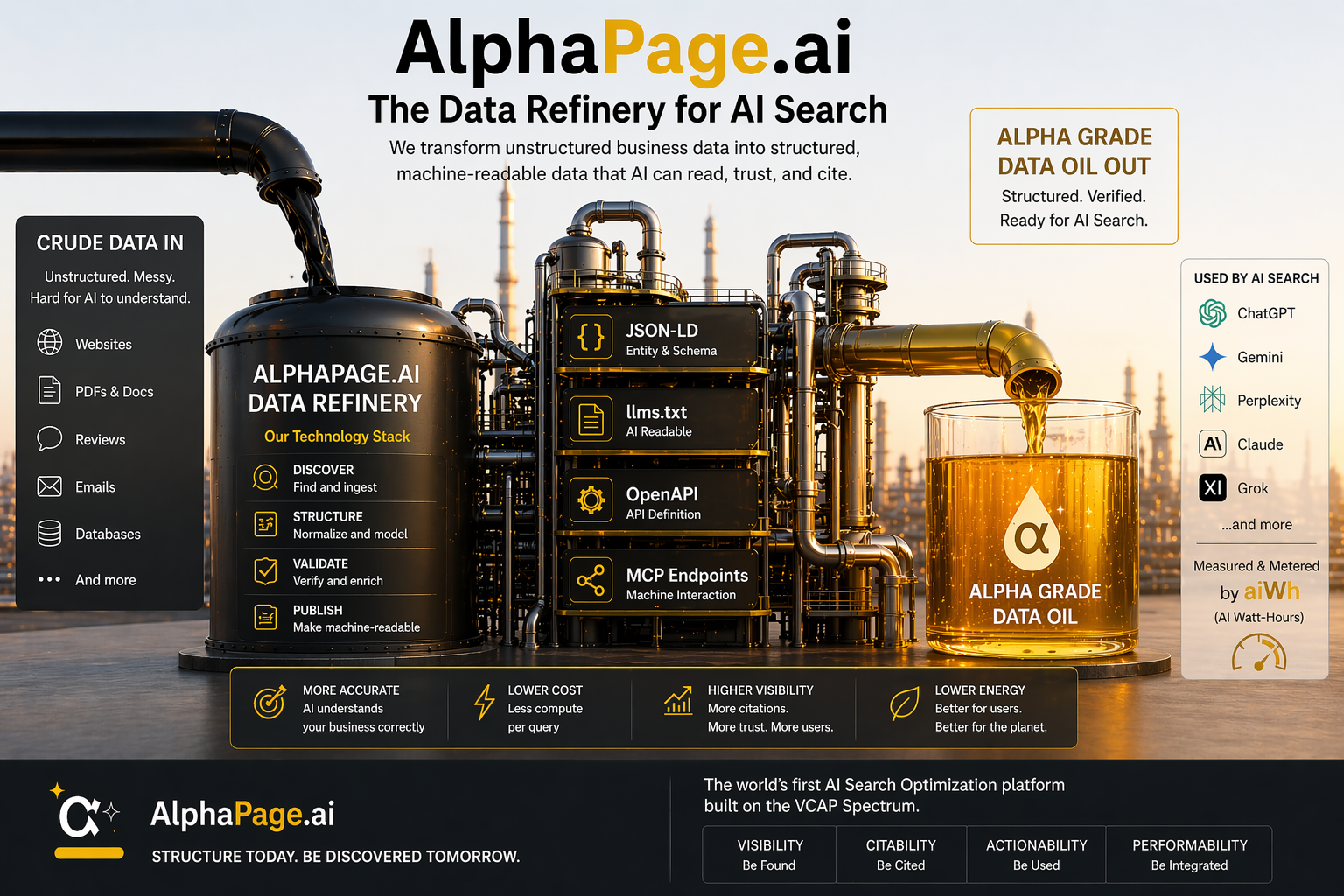
Think of it like oil grades. Every engine runs on whatever fuel it receives. Give it crude and it works harder, burns hotter, degrades faster. Give it refined and it runs clean. The engine does not change. The output does.
AI models are the engine. Information is the oil — crude or refined. The user is the driver. Intelligence is the destination. The grade of the oil determines everything.
The oil industry did not make money selling crude. It made money building the refineries. The crude is everywhere. The infrastructure to process it is not.
The Complete Metaphor
Ten elements. One framework. The entire AI search infrastructure problem — and its solution — mapped in the language of the oldest energy industry in the world.
The Refinery — Alpha Page / Gridnet AI
The refinery does not produce the crude. It does not build the engine. It does not drive the car. It does one thing: takes raw, unprocessed material and outputs the highest-grade fuel the engine can use. Alpha Page takes unstructured business data and outputs structured entity profiles — JSON-LD, llms.txt, OpenAPI, MCP endpoints — that AI models can read, parse, and cite in a single pass. Without the refinery, the engine runs on whatever it can find. With it, the engine runs clean.
The Crude Oil — Unstructured Business Data
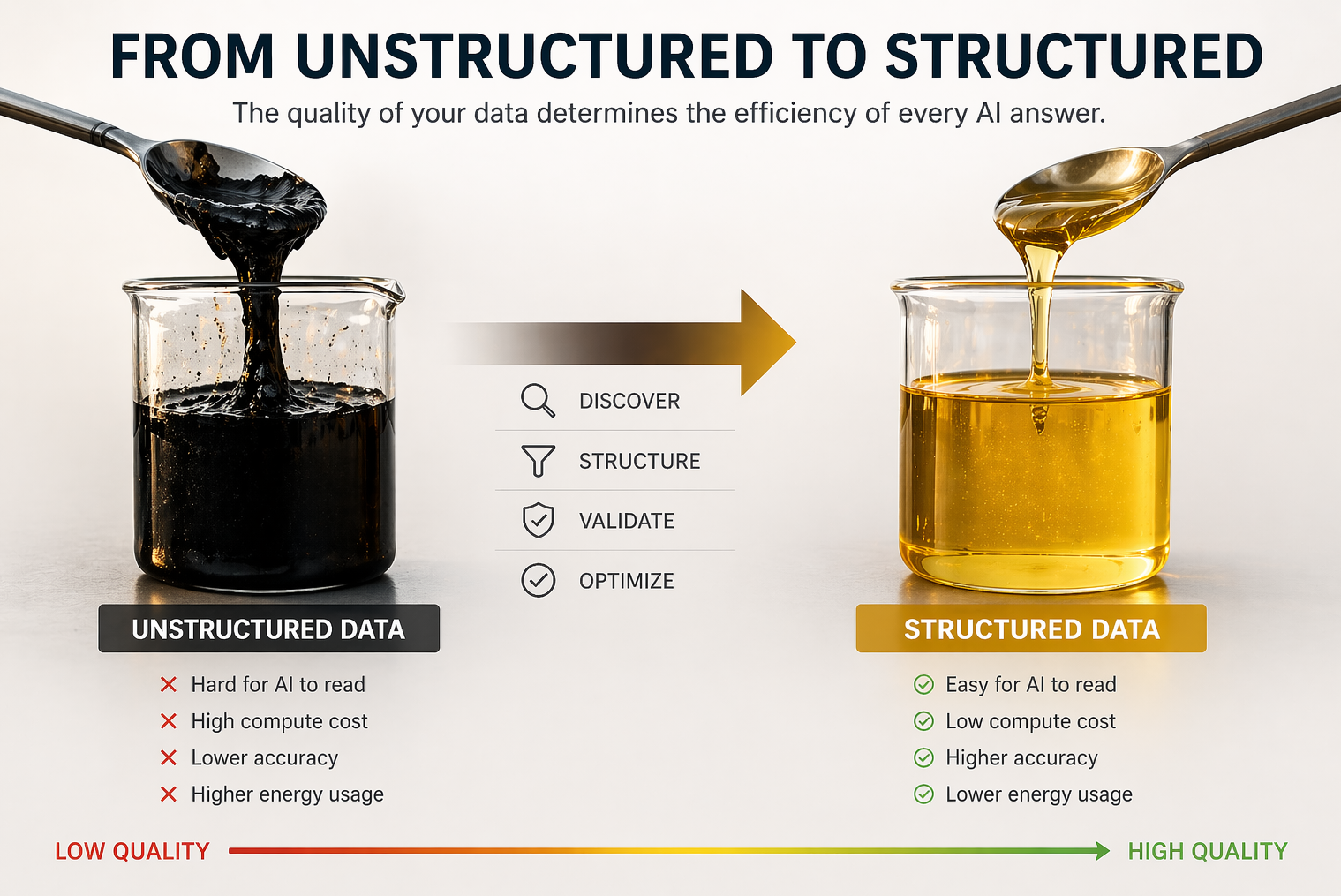
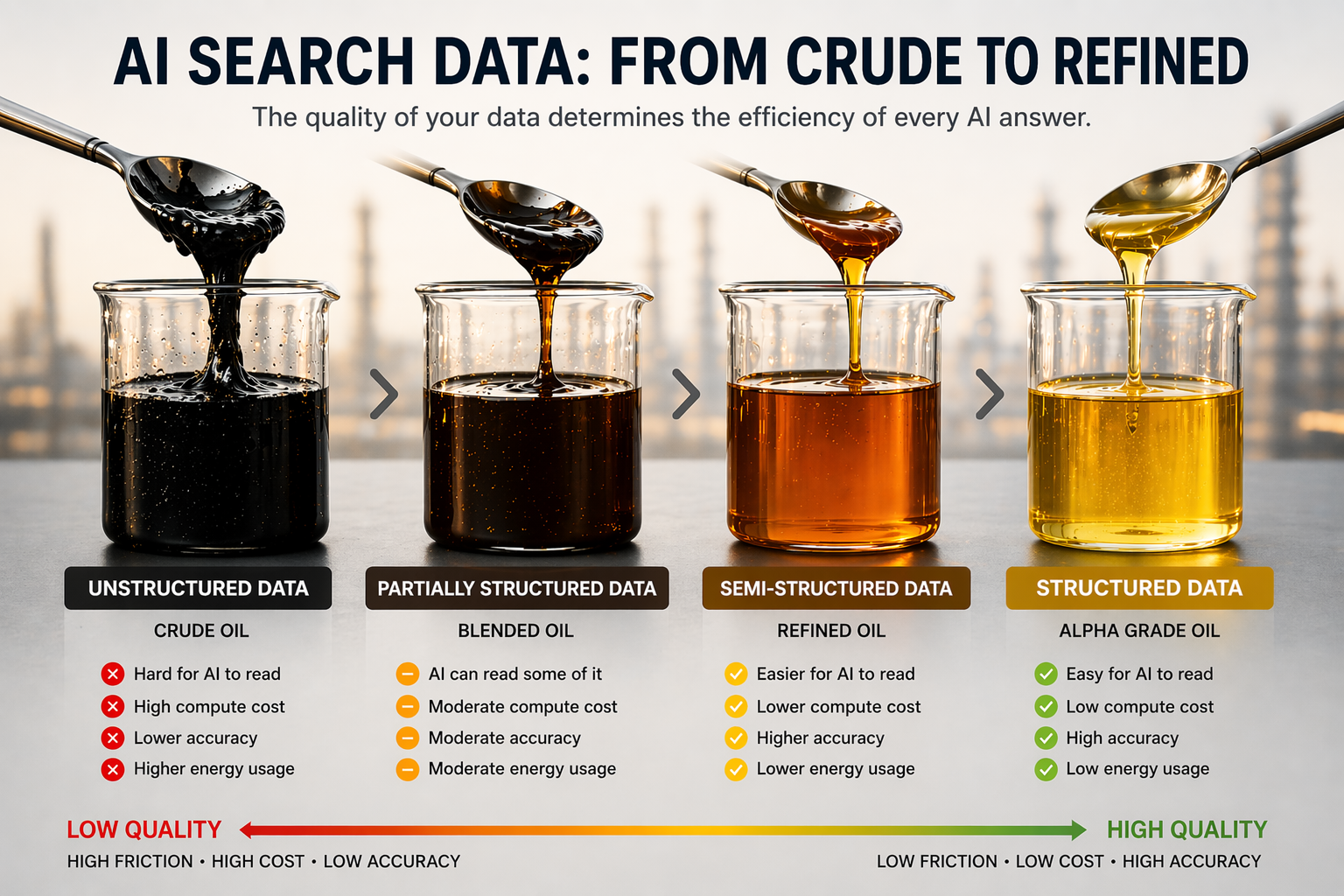
Crude oil is not useless. It contains real energy. But it cannot go directly into the engine. It has to be processed first — and if it is not, the engine pays the price. Unstructured business data is the same. A website, a PDF, a collection of inconsistent Google reviews — these contain real information. But AI models cannot read them cleanly. They have to parse, reconcile, and synthesize from conflicting sources. Every query about an unstructured business burns more energy, takes more time, and produces a less accurate answer. The information is there. The grade is wrong.
The Refined Oil — Structured Entity Data (Alpha Page)
Refined oil is the same energy as crude, restructured for the engine. Structured entity data is the same information as an unstructured website, restructured for the machine. JSON-LD schema. A verified llms.txt. An OpenAPI specification. An MCP endpoint. These are not new facts about the business — they are the same facts, formatted in the way that AI models can read without friction. The refinery did not invent the information. It made it usable.
The Engine — The AI Model
The engine does not care about the source of the fuel. It runs on whatever arrives. ChatGPT, Gemini, Claude, Grok, Perplexity — each one processes the data it finds and generates the best answer it can from what it has. Give it crude and it works harder, produces more heat, and delivers less. Give it refined and it runs at designed efficiency. The engine is not the problem and it is not the solution. It is the mechanism. The fuel is the variable.
The Driver — The User
The driver does not think about what happens in the engine. They think about the destination. They ask a question and expect an answer. When the engine runs clean — when the AI model has structured entity data to work from — the driver gets where they are going: an accurate answer, a cited business, a product recommended correctly. When the engine runs on crude, the driver feels it — as a slow response, a wrong answer, a rate limit wall, or the moment they give up and open the old search engine instead.
The Destination — Intelligence (Not Information)
The driver is not looking for information. They are looking for intelligence — the synthesized, accurate, actionable answer to the question they asked. Information is what the internet has always provided. Intelligence is what AI search is supposed to deliver. The gap between information and intelligence is the structured data gap. When businesses have unstructured data, AI models can only return information — synthesized from whatever they could find. When businesses have structured entity data, AI models can return intelligence — verified, citable, accurate. The destination is intelligence. The road to it is structured.
The Grade of the Oil — Alpha Score (0–100)
Every grade of oil has a specification. 5W-30. 10W-40. The number tells you exactly what the engine will get and how it will perform. The Alpha Score is the specification for structured AI data. A score of 0 means the AI has nothing clean to work with. A score of 100 means the entity profile is complete, verified, and machine-readable across every layer of the VCAP spectrum. Most businesses score between 20 and 45. The gap between their current score and 85 is the friction tax they are paying on every AI query about their business — measured, quantified, and fixable.
The Friction Tax — What Crude Oil Does to the Engine
When an engine runs on crude, it does not fail immediately. It degrades. The friction builds. The efficiency drops. The output suffers. The friction tax in AI search is the same process — not a single failure but a continuous degradation. Every AI query about a business with unstructured data costs more energy, takes more compute, produces a less accurate answer, and contributes to the rate limits and subscription walls that every user eventually hits. The friction tax is not paid once. It is paid on every query, by every user, on every platform, indefinitely — until the data is refined.
The Rate Limit — Engine Knock
Engine knock is the sound a driver hears when the fuel grade is wrong. It is the engine communicating that it is working harder than it should. Rate limits are the engine knock of AI search. When OpenAI caps Deep Research at 100 runs per month. When Perplexity tells you to upgrade. When ChatGPT slows mid-answer. That is the AI infrastructure communicating that it is working harder than it should — because the data it is processing was never refined for machine consumption. The driver hears the knock. The driver does not know why. The refinery knows why.
The Refinery Standard — aiWh
Every refinery operates to a standard. The standard determines what grade the output meets. The aiWh — AI watt-hour — is the measurement standard for AI search energy. It is the compute energy consumed by a single AI query, measured at the query level. A structured query costs 0.04 aiWh. An unstructured query costs up to 33 aiWh. The difference between those two numbers, multiplied by every query about a business over a year, is the energy penalty of unstructured data — quantified, auditable, and reportable. The aiWh is the instrument. Alpha Page is the refinery. The Alpha Score is the grade.
The Villain
The internet was never built for machines. It was built for humans — to read, browse, click, and navigate. Every website, every PDF, every product page, every press release was formatted for a human eye moving across a screen.
AI is forcing the internet to become something it was never designed to be: a machine-readable data layer.
The problem is not malice. It is legacy. Thirty years of content built for human consumption is now being fed to AI models that need structured signals, not prose. The AI model does not browse. It parses. And when it encounters a website full of marketing copy, inconsistent formatting, and buried product data — it does the only thing it can. It works harder. It burns more energy. It guesses where it cannot confirm.
Every unstructured business on the internet is not a bad actor. It is a legacy actor — operating with infrastructure built for a world that no longer exists as the primary interface. The friction tax is not punishment. It is physics. Crude oil in a modern engine is not sabotage. It is a mismatch between the fuel grade and the machine.
The mismatch is the villain. The refinery is the fix.
The Numbers
The energy cost of a single AI query spans a range that most people find hard to believe until they see the research behind it.
At the low end: 0.04 watt-hours for a simple structured retrieval. The AI model finds a clean entity profile, confirms the data in one pass, generates a cited answer. Fast. Precise. Cheap.
At the high end: over 33 watt-hours for a complex reasoning task on an unstructured corpus. The model runs multiple retrieval passes, reconciles conflicting sources, generates extended reasoning chains to fill gaps that structured data would have answered immediately.
That is an 800x spread. Same query. Same model. Different data.
The research comes from Jegham et al., whose benchmarking study across 30 AI models found that reasoning-heavy tasks on unstructured data consumed over 33 watt-hours per query — more than 70 times the energy of the same task on a clean, structured source. Luccioni, Jernite, and Strubell at the ACM Conference on Fairness, Accountability, and Transparency (2024) — "Power Hungry Processing: Watts Driving the Cost of AI Deployment" — confirmed the mechanism: energy consumption scales directly with computational complexity, and unstructured parsing is among the most computationally expensive tasks an AI model performs.
The spread is not a theoretical maximum. It is the real operating range of AI search today — with most businesses sitting at the expensive end because they have never built structured entity data infrastructure.
The Cost Cascade You Are Already Paying
The energy cost of unstructured data does not stay in the data center. It passes through every layer of the AI pricing stack until it reaches the user.
Energy cost (kWh)
  → GPU compute cost ($/hour)
    → Token cost ($/million tokens)
      → API pricing (passed to developers)
        → Subscription pricing (passed to users)
You are here → Rate limits (the energy cost expressed as access scarcity)
Every rate limit on an AI platform is energy cost expressed as access scarcity. The cap on Deep Research runs. The upgrade prompt on Perplexity. The wait screen on ChatGPT. These are not arbitrary product decisions. They are the energy bill of a system that has to work too hard because the data it is working on was never structured for machine consumption.
The business whose data caused the extra compute pays nothing. The user at the bottom of the cascade pays with rate limits, subscription tiers, and degraded answers.
You Have Already Felt This
You just did not know what you were looking at.
When ChatGPT slows down mid-answer. When Perplexity tells you to upgrade. When a response cuts off or takes longer than expected. When you ask about a local business and the AI hedges, qualifies, or gets the hours wrong.
That is not a product decision.
That is the system hitting an energy ceiling.
That is the cost of unstructured data — expressed as friction, felt by you, at the bottom of the cascade that started with a business that never structured its entity data.
The driver hears the engine knock. The driver blames the car. The problem is the fuel.
What Structured Data Actually Means for a Query
When an AI model is asked about a business, it does not go directly to the answer. It goes to the data first. What happens next depends entirely on the quality of that data.
Structured query — the clean path:
A business has an Alpha Page. The entity profile contains JSON-LD schema, a verified llms.txt, and an OpenAPI specification. The model retrieves the entity profile in one pass. It generates a cited answer. Transaction complete.
Token count: low. Retrieval passes: one. Energy cost: 0.04 watt-hours. Answer quality: accurate.
Unstructured query — the expensive path:
A business has a website with marketing copy, conflicting Google reviews, and a PDF brochure last updated in 2021. The model searches. It pulls from multiple sources that conflict. It reconciles address formats, outdated hours, product names that do not match across platforms. It builds a longer reasoning chain. In the worst case it hallucinates — generating confident, plausible, incorrect information.
Token count: high. Retrieval passes: multiple. Energy cost: up to 33 watt-hours. Answer quality: degraded.
The difference is not the question. It is the data.
| Structured (Alpha Page) | Unstructured (Standard Website) | |
|---|---|---|
| Retrieval passes | 1 | 3–10+ |
| Token count | Low (200–500) | High (5,000–50,000) |
| Query energy | 0.04 Wh | Up to 33 Wh |
| Energy ratio | Baseline | Up to 800x baseline |
| Answer accuracy | High — verified entity data | Variable — synthesized from conflict |
| Hallucination risk | Eliminated | Elevated |
| Cost to user | No rate limit impact | Contributes to cascade |
| Cost to business | Captured revenue | Lost to competitor citation |
The GEO/AEO Problem: SEO on Steroids Is Not the Answer
Here is the move most businesses make when they discover the AI visibility gap. They spam the internet.
More blog posts. More press releases. More LinkedIn updates. More directory listings. More social profiles. The logic is inherited directly from SEO: get indexed on every platform available, force-feed the AI model through volume, and hope that sheer content mass drives a citation.
This is SEO on steroids. And it is still unstructured.
Spamming every platform does not give AI models machine-readable entity data. It gives them more pages of unstructured text to parse, reconcile, and synthesize. Every additional inconsistent source — a Yelp listing with the wrong address, a press release with an outdated product name, a social bio that contradicts the website — adds to the retrieval burden. More passes. More tokens. More energy. More friction.
The friction tax does not decrease with content volume. It increases.
Generative Engine Optimization (GEO) and Answer Engine Optimization (AEO) are the disciplines that replace the spray-and-pray approach with structured infrastructure. GEO is the back-end — building the machine-readable entity profiles, JSON-LD schema, llms.txt files, and OpenAPI specifications that allow AI models to retrieve and cite a business in a single pass. AEO is the front-end — optimizing the authority signals and citation patterns that determine whose structured data gets cited when an AI model answers a direct question in a given category.
The distinction matters for the energy argument:
- Unstructured content at scale (the SEO-on-steroids approach) → more sources to reconcile → higher token cost → higher energy cost → higher friction tax
- Structured entity infrastructure (GEO/AEO) → single authoritative source → one-pass retrieval → minimum token cost → minimum energy cost → friction tax eliminated
The companies hiring GEO/AEO practitioners right now — Okta at $132K–$181K, OutSystems at $183K–$222K, Skechers at $100K–$140K — are not hiring writers to produce more content. They are hiring infrastructure builders. The job postings that require experience with RAG, vector embeddings, entity graphs, and JSON-LD are building the structured layer. The ones that ask for "answer-first blog posts" and "topic clusters" are still treating AEO as a content strategy — and paying for it in energy and missed citations.
The market has not yet separated these disciplines clearly. That is the positioning gap Alpha Page fills.
AI Search for Banks: The Highest-Stakes Version of the Problem
Financial services is where the unstructured data problem becomes a compliance event.
A family sits down on a Sunday evening to research buying their first home. They open a laptop and ask ChatGPT: "What are the best mortgage options for a first-time homebuyer?"
The AI answers immediately. Confidently. With specific rates, product names, and lender recommendations.
The bank they have used for eleven years — where they have their checking account, their car loan, and their business checking — is not mentioned once. Not because that bank does not offer mortgages. Not because their rates are uncompetitive. Because the AI model could not find their product data in a form it could read, parse, and trust.
That bank lost a mortgage consideration before the customer ever made a phone call. And the AI may have cited a competitor's rate that has not been accurate for six months.
In financial services, this is not a marketing problem. It is a regulatory event.
Under Regulation Z — the Truth in Lending Act — the terms a consumer relies on when making a credit decision must be accurate. When an AI model is the intermediary delivering those terms from unstructured data, the institution has no control over what gets said. The CFPB has been explicit: there is no technology exemption. The institution is responsible for the accuracy of information about its products, regardless of the channel through which a customer receives it.
The AI visibility gap in financial services maps directly to the energy gap:
- Unstructured bank data → AI model runs multiple retrieval passes trying to find current rates → conflicting sources from rate comparison sites, press releases, and outdated product pages → longer reasoning chain to reconcile → hallucination risk → wrong rate cited to customer → potential CFPB, UDAAP, TISA exposure
- Structured bank data (Alpha Page) → AI model retrieves the verified entity profile in one pass → current, compliance-locked rates and terms → accurate citation → no hallucination → no regulatory event
The energy cost and the compliance cost are the same cost, expressed differently. Both are eliminated by the same infrastructure.
The job market confirms the urgency. A major regional bank — one of the top 10 in the US by assets — posted an AI Search Strategy Lead role in April 2026, salary range $65K–$161K. The mandate was not marketing performance. It was compliance accuracy and AI visibility simultaneously. The bank has approved the budget. The function is being built. The question is whether they build it with a $161K hire doing it manually or with infrastructure that does it programmatically.
For the full regulatory framework — CFPB, UDAAP, Regulation Z, TISA, RESPA, FINRA, OCC — see The AI Visibility Gap in Financial Services.
The ESG Dimension: Where the Energy Story Becomes a Balance Sheet Story
For institutional investors and enterprise CFOs, the energy argument closes here.
ESG — Environmental, Social, and Governance — is not ethics. It is capital markets infrastructure. As of 2024, over $30 trillion in assets under management uses ESG criteria in investment decisions. BlackRock, Vanguard, State Street — the largest asset managers in the world — require ESG disclosures from the companies they invest in. A poor ESG score raises your cost of capital. A strong one lowers it. The difference is measured in basis points. At scale, basis points are worth millions.
The AI energy footprint is now on that scorecard.
A company that can demonstrate reduced AI energy consumption per query — with a quantifiable, auditable measurement unit — has a direct ESG contribution. Not a pledge. Not an intention. A number. Measured at the query level. Aggregated across every AI search about their business. Reportable to ESG auditors.
No GEO or AEO platform has made this argument before. No competitor is making it. It requires three things none of them have:
1. A measurement unit. The aiWh — AI watt-hour — is the compute energy unit for a single AI search query. Gridnet built it. No competitor has it.
2. A mechanism. Monitoring what AI says about you does not reduce energy consumption. Building a structured entity profile that allows AI models to answer queries with one retrieval pass instead of ten does. That mechanism is the Alpha Page.
3. An infrastructure layer. A single structured entity profile reduces the energy cost of every future query about that business — across every AI model, every platform, every user, indefinitely. It compounds. It is auditable. It is what ESG reporting requires.
The ESG case maps across all three pillars:
Environmental — Structured entity data reduces AI query energy by up to 70 percent per query. At enterprise scale, that reduction is measurable in terawatt-hours. It directly addresses Scope 3 emissions reporting. Every business that builds an Alpha Page makes a quantifiable environmental contribution.
Social — The AI visibility gap is not evenly distributed. Small businesses have the most unstructured data and the lowest AI citation rates. The District One AI Readiness Study — 273 businesses in San Antonio, Texas — is the first civic research project to measure this equity dimension at the local business level. Alpha Page is the tool that closes it.
Governance — In regulated industries, structured entity data is the compliance layer that prevents AI hallucinations about financial products, medical guidance, and legal terms. It is the governance infrastructure that regulators will eventually require. Building it now is a competitive moat.
Alpha Page is ESG infrastructure for AI. The business that builds a clean entity profile is not just improving its AI visibility. It is making a quantifiable, auditable reduction in AI energy consumption — and that reduction has real value on a balance sheet.
For the full investor-facing ESG argument — including the balance sheet model, the Techstars Alabama EnergyTech frame, and the competitive moat analysis — read The ESG Dimension: Alpha Page as AI Energy Infrastructure.
The Right Grade for the Right Engine

Not all data needs to be Alpha Grade. Like crude oil, every grade has a purpose. The key is using the right grade for the right engine.
The oil barrel is not a hierarchy of quality — it is a spectrum of fitness. Crude oil in a heating furnace is perfectly appropriate. Crude oil in a Formula 1 engine is catastrophic. The grade does not determine value. The match between grade and application does.
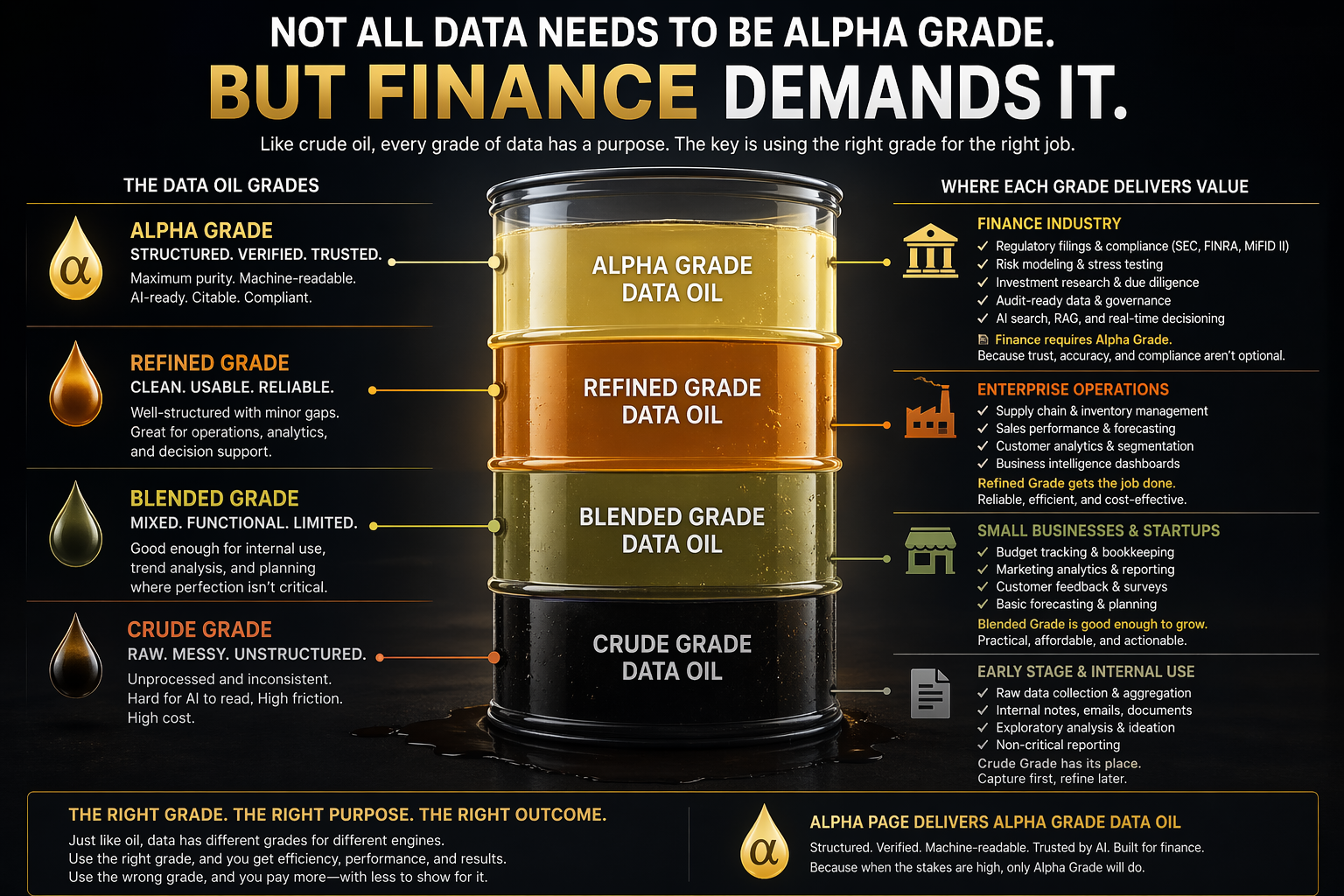
The data grades for AI search work the same way. Four grades. Four use cases. Each one appropriate for a different engine running at a different stakes level.
Crude Grade — Raw. Messy. Unstructured.
A startup in its first 90 days. Internal notes, emails, Notion docs, raw customer feedback. Unprocessed and inconsistent, hard for AI to read, high friction if queried externally — but perfectly appropriate for internal ideation, early data collection, and exploratory analysis where perfection is not the goal. Capture first. Refine later. Crude grade has its place. It is not the destination.
Blended Grade — Mixed. Functional. Limited.
A small business with a Google Business Profile, a basic website, and a few consistent directory listings. AI can read some of it. The compute cost is moderate. The accuracy is moderate. Good enough for budget tracking, basic marketing analytics, and planning where precision is not critical. Most small businesses and early-stage startups live here. Blended Grade is good enough to grow — but not good enough to compete in AI search against a business running Alpha Grade.
Refined Grade — Clean. Usable. Reliable.
An enterprise with a well-maintained CMS, consistent product data across platforms, and partial schema markup. AI can read most of it. Lower compute cost than crude. Higher accuracy. Appropriate for enterprise operations — supply chain management, sales forecasting, customer analytics, business intelligence dashboards. Refined Grade gets the job done for operational contexts where the stakes of a wrong answer are recoverable.
Alpha Grade — Structured. Verified. Trusted.
The only grade appropriate when trust, compliance, and citation accuracy are not optional. Maximum purity. Machine-readable. AI-ready. Citable. Compliant.
Finance requires Alpha Grade. Not because of preference — because of consequences.
When an AI model cites the wrong interest rate on a mortgage product, the consequence is not a bad search result. It is a CFPB examination. When an AI model misrepresents a credit card's APR, the consequence is not a missed click. It is a UDAAP violation. When an AI model describes a savings account with an outdated yield, the consequence is not a low ranking. It is a Regulation DD accuracy failure.
The same principle applies across every high-stakes category:
Healthcare requires Alpha Grade because an AI model citing the wrong dosage, contraindication, or coverage exclusion is a patient safety event.
Legal services require Alpha Grade because an AI model misrepresenting a filing deadline, jurisdiction rule, or fee structure creates professional liability exposure.
Insurance requires Alpha Grade because AI-generated coverage descriptions that do not reflect actual policy terms create claims disputes and regulatory exposure.
Any business where the cost of a wrong AI answer exceeds the cost of structuring the data correctly requires Alpha Grade. The calculation is straightforward. The implementation is what Alpha Page provides.
The right grade. The right engine. The right outcome.
The Measurement: aiWh
Every refinery operates to a standard. The standard is not aspirational — it is measured. Every barrel of oil that leaves a refinery has a specification: viscosity, purity, energy density. The grade is not a marketing claim. It is an auditable number.
The aiWh — AI watt-hour — is the measurement standard for data grade in AI search. It is the compute energy consumed by a single AI query, measured at the query level. A structured Alpha Grade query costs 0.04 aiWh. An unstructured crude query costs up to 33 aiWh.
That difference — multiplied by every query about a business over a reporting period — is the energy penalty of the wrong data grade. Quantified. Auditable. Reportable to ESG auditors, regulatory examiners, and CFOs who need a number, not a narrative.
The aiWh is not an abstraction. It is already live in the Alpha Page platform. Every search query run through alphapage.ai is metered. Every Alpha Score includes the aiWh baseline for that entity. The measurement system exists.
The District One AI Readiness Study — 273 local businesses in San Antonio, Texas — is building the first empirical dataset that maps data grade to aiWh cost at the local business level. When complete, it will be the first published evidence that the 800x energy range is not a theoretical benchmark — it is a measurable reality for ordinary businesses operating with ordinary data.
The research paper is scoped:
"AI Search Transaction Costs: Measuring the Energy Penalty of Unstructured Business Data in Generative AI Queries"
The instrument is built. The data is being collected. The standard will be published.
The Only Path Forward
Unstructured data makes AI think.
Structured data lets AI know.
Thinking is expensive. Knowing is efficient.
AI search cannot scale on unstructured data. Not economically — the token cost multiplies with every reconciliation pass. Not technically — multi-pass retrieval on conflicting sources degrades with volume, not improves. Not environmentally — the IEA projects AI data center energy consumption doubling to 945 terawatt-hours by 2030, and unstructured data is the primary driver of per-query inefficiency.
Structured data is not an optimization. It is the only path forward.
Every industry that faced an energy constraint built infrastructure to solve it. The oil industry built refineries. The internet built CDNs — content delivery networks that pre-positioned data closer to users so it did not have to travel the full distance on every request. AI search will build structured data layers — pre-processed entity profiles that give AI models exactly what they need before they start searching.
Alpha Page is that layer. The market will converge on it. The question is who builds the standard.
The Bottom Line for Investors
The AI search infrastructure market is forming now. The terminology is not settled — nine different terms across 14 job postings in April 2026. The tooling ecosystem is incomplete. No competitor has attached a measurement unit to the energy cost of unstructured data. No competitor has made the ESG argument. No competitor has built the compliance layer for regulated industries.
The companies that define the vocabulary, publish the canonical content, and build the infrastructure layer in the next 12 months will own this category for the next decade — the same way Google Analytics owned web analytics and SEOmoz owned SEO data.
Three market signals confirm the window:
The job postings. Fewer than 50 GEO/AEO jobs on ZipRecruiter in April 2026. Same count SEO had in 2001. The companies hiring now — Okta, OutSystems, Skechers, a major regional bank — have approved budgets, assigned internal owners, and are actively shopping for infrastructure tools.
The competitor gap. Every named competitor — Goodie AI, Profound, Peec, Brand Radar — is a measurement layer. They tell clients what AI says about them. None of them publish structured entity data. None of them have an energy measurement unit. None of them have a compliance framework. Every Goodie AI client who receives a gap analysis report still needs somewhere to close the gaps. That somewhere is Alpha Page.
The regulatory trajectory. The CFPB, the IEA, and the SEC are all developing frameworks that will eventually touch AI search accuracy and AI energy disclosure. The institutions building structured infrastructure now will have a compliance head start when those frameworks arrive with teeth.
The window is open. The meter is running. The refinery is being built.
Frequently Asked Questions
What is the 800x energy gap? Research benchmarks show that a structured AI query — one where the business has clean, machine-readable entity data — consumes as little as 0.04 watt-hours. An unstructured query requiring multi-pass retrieval and extended reasoning can consume over 33 watt-hours. That is an up-to-800x spread driven entirely by data quality.
Why is content volume not the solution? Publishing more unstructured content increases the number of sources an AI model has to reconcile, which increases token cost and energy consumption. GEO/AEO infrastructure — structured entity profiles — reduces retrieval to a single pass, eliminating the reconciliation burden entirely.
What is an aiWh? An AI watt-hour — the compute energy unit for a single AI search query. Gridnet AI built this measurement standard to make the energy cost of AI search quantifiable at the query level. It is the foundation of the ESG argument for structured entity data.
Why do banks have the highest stakes? In financial services, unstructured AI data creates compliance exposure under CFPB, UDAAP, Regulation Z, TISA, and RESPA. A hallucinated interest rate is not a search ranking error — it is a regulatory event. The energy cost and the compliance cost are the same problem, solved by the same structured data infrastructure.
What is the ESG connection? A business that reduces AI query energy consumption through structured entity data has a quantifiable Scope 3 emissions reduction. With $30 trillion in assets under management using ESG criteria, that reduction directly affects cost of capital. Alpha Page is the first AEO/GEO platform with a measurement unit, a mechanism, and an infrastructure layer sufficient to make this case.
Run your Alpha Score at alphapage.ai — see your current structured data coverage and what it is costing every AI query about your business.
The full regulatory framework for banks — read The AI Visibility Gap in Financial Services
The investor ESG brief — read The ESG Dimension: Alpha Page as AI Energy Infrastructure
The user-facing story — read Big Search Energy
How to Get Cited by AI — v1.0. Get early access at howtogetcitedbyai.com.
Legal Disclaimer
The information in this article is provided for general informational and educational purposes only and does not constitute legal, compliance, regulatory, or investment advice. Financial institutions should consult qualified legal counsel and compliance professionals regarding their specific regulatory obligations. Investors should consult qualified financial advisors regarding investment decisions. Regulatory guidance referenced is based on publicly available agency publications current as of the publication date and is subject to change.
This article is a chapter preview.
How to Get Cited by AI — v1.0 is the complete guide to GEO, AEO, and AI Search. Get early access when it drops.
Get Early Access →Get notified when the book drops.