What Is AEO? Answer Engine Optimization Explained
Fortune 500 companies are hiring for it. Here is what it actually is.
Definition
AEO (Answer Engine Optimization) is the practice of ensuring a business is the authoritative source cited in AI-generated answers.
AEO determines who AI models trust enough to cite.
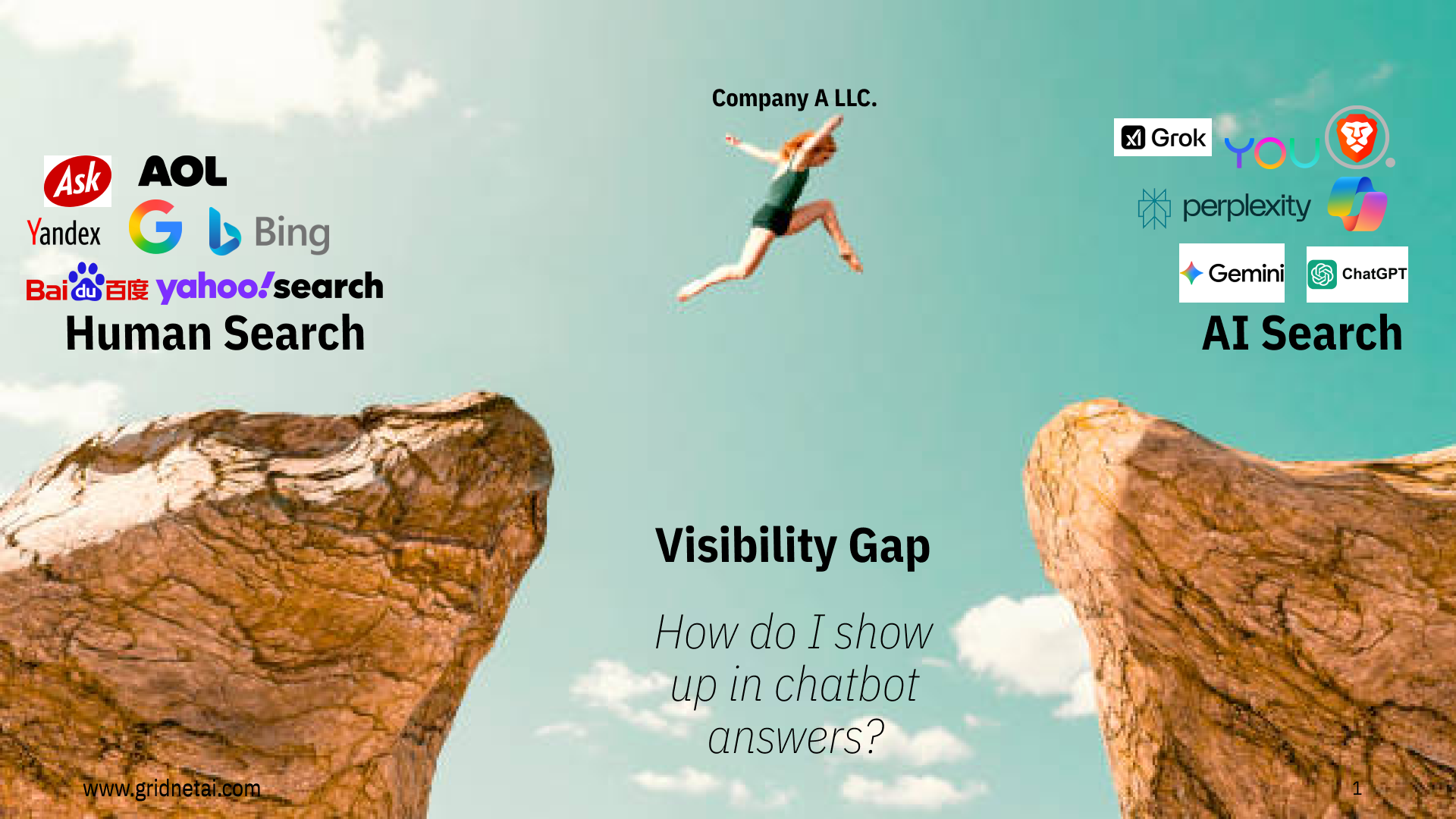
Look at that image.
On the left: every search engine humans have used for the last thirty years. Google. Bing. Yahoo. Ask. AOL. Baidu. The platforms built on the assumption that people type keywords and click links.
On the right: the new platforms. ChatGPT. Gemini. Perplexity. Grok. Copilot. The platforms built on the assumption that people ask questions and get answers.
In the middle: a gap. And a business trying to jump across it.
That gap has a name. It is the AI visibility gap. And the discipline that closes it is called AEO — Answer Engine Optimization.
What AEO Stands For
AEO stands for Answer Engine Optimization.
An answer engine is an AI platform that delivers direct answers to questions — as opposed to a list of links to explore. When you ask ChatGPT "what is the best savings account for a small business," it gives you an answer. One answer. Possibly two or three options. But not ten blue links.
Answer Engine Optimization is the practice of ensuring your business is the one being cited in those answers.
Not just found. Not just mentioned. Cited — as the authoritative source.
That distinction matters. In traditional search, ranking #3 still got you traffic. In AI search, if you are not the cited source, you effectively do not exist in that response.
How AEO Differs From GEO
GEO — Generative Engine Optimization — is the foundation. It is the full infrastructure of your AI visibility: the structured data signals, the entity definitions, the machine-readable profiles that tell AI models who you are and what you do.
AEO is the fine-tuning layer on top of that foundation.
Once your GEO infrastructure is in place, AEO is about becoming the answer — not just a result. It is about optimizing for the specific moment when an AI model synthesizes a response to a direct question in your category and decides whose information to trust.
Think of it this way:
GEO gets you into the room. AEO gets you to the front of the room.
GEO vs SEO vs AEO: The Full Comparison
| SEO | GEO | AEO | |
|---|---|---|---|
| Goal | Rankings on a results page | Visibility in AI-generated answers | Citation as the authoritative source |
| Output | A ranked link | Structured data AI can read | An answer attribution |
| Metric | Traffic, click-through rate | AI visibility, citation rate | Share of voice in AI answers |
| User action | Clicks your link | May not click at all | No click — answer is delivered directly |
| Foundation | Keywords and backlinks | Machine-readable structured data | Verified entity data + authority signals |
| Layer | Web presence | AI infrastructure | Citation authority |
SEO, GEO, and AEO are sequential layers, not competing disciplines. SEO built the web presence. GEO builds the machine-readable layer. AEO fine-tunes that layer for citation authority in direct answers.
Why AEO Matters Right Now
Major financial institutions, healthcare systems, law firms, and retailers are actively hiring for roles with titles like "AI Search Strategy Lead," "AEO Specialist," and "Generative AI Visibility Manager." The salary ranges are significant — comparable to senior marketing or technical roles.
The reason is not hard to understand.
When a prospective customer asks an AI model "which bank has the best mortgage rates for first-time buyers" — that AI model delivers an answer. If the institution is not structured to be cited accurately in that answer, it loses the consideration entirely. No click. No visit. No application.
The zero-click future is not hypothetical. It is the present.
And the businesses that have built AEO infrastructure are the ones being cited. The ones that have not are invisible — regardless of how good their product is or how well their website ranks on Google.
The YMYL Problem
Not all AEO is equal. Some categories carry significantly higher stakes than others.
YMYL stands for Your Money Your Life. It is a framework originally developed by Google to flag content where inaccurate information could cause real harm — financial advice, medical guidance, legal counsel, insurance coverage.
AI models apply extra scrutiny to YMYL content. They are more cautious about citing sources they cannot verify. They are more likely to hallucinate in areas where the correct answer requires specific, up-to-date, compliant data.
For businesses in these categories — banks, insurers, healthcare providers, law firms, financial advisors — AEO is not just a marketing advantage. It is a compliance imperative.
When an AI model tells a customer the wrong interest rate on a mortgage, the wrong coverage exclusion on an insurance policy, or the wrong filing deadline on a tax matter — that is not a search ranking problem. That is a regulatory event.
Structured, verified, machine-readable data is what prevents it.
What AEO Infrastructure Looks Like
AEO is built on the same VCAP Spectrum as GEO — from READ to WRITE to ACT.
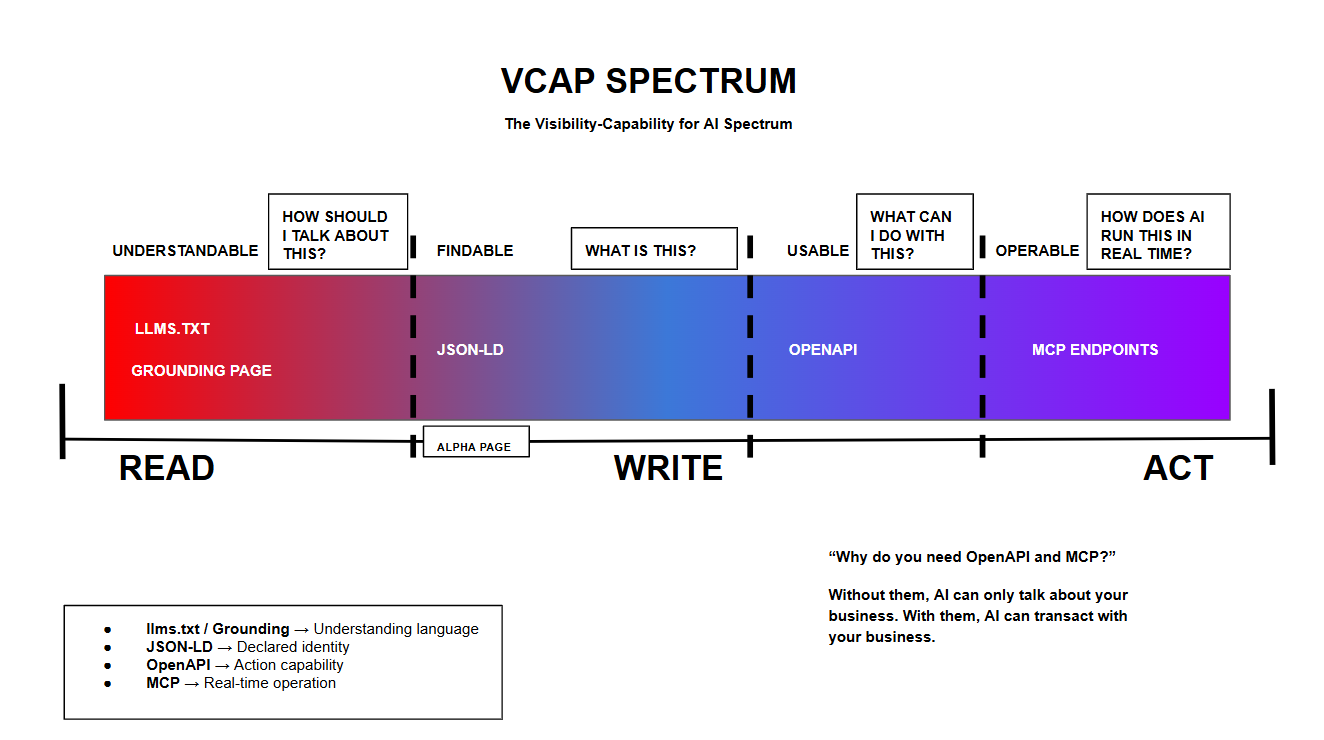
The spectrum matters for AEO because being cited accurately is not just about being found. It is about being trusted. And trust, in the language of AI models, is built through the quality and completeness of your structured data signals.
At the READ layer — llms.txt and grounding pages tell AI models how to talk about your business. What terminology to use. What your products actually do. What claims you can and cannot make. This is the compliance layer for YMYL businesses.
At the FINDABLE layer — JSON-LD schema markup declares your entity. Your business name, category, location, products, services, and key attributes — structured so every AI model can parse them unambiguously. This is what gets you into the citation pool.
At the WRITE layer — OpenAPI Specification means AI agents can do more than talk about you. They can query your systems. Check your availability. Retrieve accurate, real-time product data. This is where AEO starts to become a revenue channel, not just a visibility channel.
At the ACT layer — MCP Endpoints mean AI models can transact with your business in real time. Book appointments. Process inquiries. Return personalized results. This is the future most businesses have not built for yet.
Most AEO work today lives in the READ and FINDABLE layers. That is where the citation wins are. But the businesses building toward WRITE and ACT are the ones who will dominate AI-mediated commerce in the next three to five years.
The Four Things AEO Requires
1. Accurate entity definition
AI models need to know unambiguously who you are. Not just your name — your category, your geographic service area, your founding, your regulatory identifiers, your key personnel. Disambiguation is everything. There are thousands of businesses with similar names. Structured entity data is what separates you from the noise.
2. Verified product and service data
For AEO to work, the data AI models cite needs to be accurate. That means maintaining structured data that reflects your current offerings — current rates, current terms, current coverage, current availability. Stale data is worse than no data in high-stakes categories because AI models will cite it confidently.
3. Authoritative content signals
AI models decide who to cite partly based on authority signals — the same logic as SEO backlinks, but for machines. Consistent information across platforms. High-quality citations from other authoritative sources. A track record of accurate, reliable data. These signals accumulate over time and compound.
4. Compliance-aware structuring
For YMYL businesses, AEO content must be structured in a way that AI models can cite without creating regulatory exposure. This means building disclaimers and regulatory context into the structured data itself — not just on the website.
AEO vs SEO: The Key Differences
The instinct many businesses have is to treat AEO as an extension of SEO. Same discipline, new platform. That instinct is half right and half wrong.
The half that is right: content quality still matters. Authority still matters. Consistency and accuracy still matter.
The half that is wrong: the mechanics are completely different.
SEO rewards volume — more pages, more keywords, more content. AEO rewards precision — cleaner data, more accurate entity definitions, more machine-readable structure.
SEO is measured in clicks and rankings. AEO is measured in citations and share of voice in AI answers.
An SEO professional who understands these differences is already a GEO/AEO professional. They just need the right tools and framework to apply what they know to the new environment.
How to Start with AEO
Step one — Run your AI search diagnostic. Go to alphapage.ai/search and run a search for your business. See what AI models actually say about you right now. That is your baseline.
Step two — Score your current AI visibility. The Alpha Score measures how visible and citable you are across six AI visibility signals. A score below 50 means you have significant gaps. A score above 70 means you are visible but have room to optimize.
Step three — Build your Alpha Page. A structured AI visibility profile that covers the VCAP Spectrum — llms.txt, JSON-LD, and the groundwork for OpenAPI and MCP as you scale.
Step four — Monitor and maintain. AEO is not a one-time project. AI models update. Competitors improve their structured data. Your products change. The businesses that win at AEO treat it as ongoing infrastructure, not a campaign.
Frequently Asked Questions
What is AEO in simple terms? AEO is how businesses ensure that when an AI model answers a question in their category, their business is the one being cited as the authoritative source.
What is the difference between AEO and GEO? GEO builds the infrastructure — the full machine-readable foundation of AI visibility. AEO fine-tunes that infrastructure for citation authority. GEO gets you into the room. AEO gets you to the front of it.
What is the difference between AEO and SEO? SEO optimizes for ranked links. AEO optimizes for direct citation in AI answers. SEO rewards content volume and keyword coverage. AEO rewards data precision, entity clarity, and authority signals.
Which businesses need AEO most? Any business operating in a YMYL category — financial services, healthcare, legal, insurance — has the highest stakes for AEO accuracy. But any business that wants to appear in AI-generated answers when customers ask questions in their category needs AEO infrastructure.
How do I know if my business is being cited by AI? Run a search for your business category at alphapage.ai/search and see how AI models currently respond to queries in your space. Your Alpha Score will show you where your citation infrastructure has gaps.
What does AEO cost? The starting point — an Alpha Page with llms.txt and JSON-LD — is available at alphapage.ai. Enterprise managed service for regulated industries is scoped based on the number of entities and maintenance requirements.
Start with the foundation — read What Is GEO? Generative Engine Optimization Explained to understand the infrastructure layer that AEO is built on.
See AEO applied to financial services — read The AI Visibility Gap in Financial Services for the highest-stakes application of AEO in regulated industries.
How to Get Cited by AI — v1.0 covers GEO, AEO, and AI Search in full. Get early access at howtogetcitedbyai.com.
This article is a chapter preview.
How to Get Cited by AI — v1.0 is the complete guide to GEO, AEO, and AI Search. Get early access when it drops.
Get Early Access →Get notified when the book drops.