Yellow Pages, Blue Links, and AI: The History of How Businesses Get Found
Every era has new rules. Here is the full arc — and the twist ending.
The rules for how a business gets found have rewritten themselves four times in the last 150 years. Each time, the businesses that adapted first captured outsized advantage. The businesses that waited adapted to a market that had already moved on without them.
We are in the middle of the fifth rewrite right now.
Understanding the arc — where we came from, what each era required, and why each one ended — is the fastest way to understand what the current era demands. And to avoid repeating the mistakes that cost businesses everything in the last transition.
Era One: If Your Name Was in the Book, You Existed
1880s — 1990s · The Yellow Pages Age
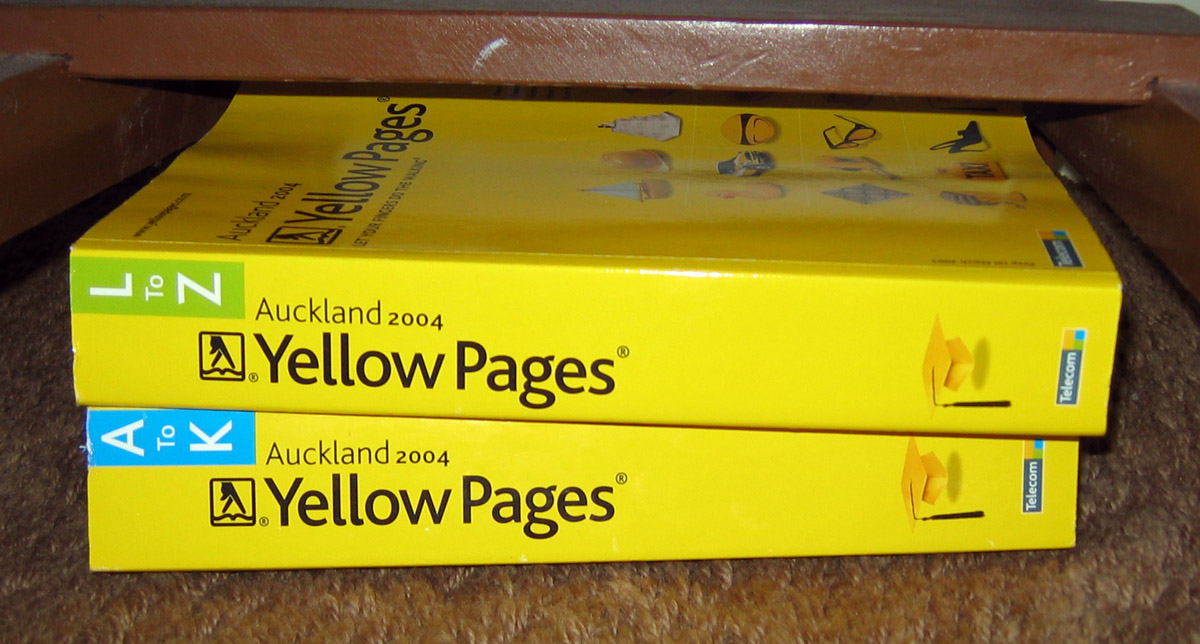
In 1886, the first Yellow Pages directory was printed in Cheyenne, Wyoming. A printer ran out of white paper and substituted yellow. The color stuck. Within a decade, every city in America had one.
The Yellow Pages was the original structured data system for local business. Every listing followed the same format: business name, category, address, phone number. Standardized. Alphabetized. Printed once a year and dropped on every doorstep.
The rules of this era were simple and brutal. If your business was in the book, you existed. If it was not, you did not. There was no in-between. No partial credit for word of mouth. No bonus for having a nice storefront. The book was the index of commercial reality.
The strategy was equally simple: be in the right category, have the right name, and buy the largest ad your budget allowed. Businesses renamed themselves to appear first alphabetically. "A-1 Plumbing." "AAA Locksmith." "Aardvark Towing." The gamification of the directory was immediate and universal.
The core rule of Era One: be in the book, be in the right category, be easy to find on the page. The business that grasped these three rules early could dominate a local market for a decade without doing anything else.
At its peak in the 1990s, AT&T's Yellow Pages division generated over $10 billion in annual revenue. Businesses spent enormous portions of their marketing budgets on directory placement. An accounting firm in Dallas might spend $40,000 a year just to appear in a full-page ad under "Accountants" in the Dallas Yellow Pages.
And then the web arrived. The book became a doorstop. Literally.
Era Two: The Address Was the Answer
1994 — 1998 · Before Google
The first wave of web discovery was not search. It was directories again — just digital ones.
Yahoo launched in 1994 as a manually curated list of websites organized by category. It looked exactly like the Yellow Pages, transposed to a screen. Humans reviewed websites and placed them in the right folder. "Business and Economy." "Science." "Arts." You submitted your site, a Yahoo editor approved it, and you were in the index.
The rules were familiar: be listed, be categorized correctly, and be found. The medium was new. The logic was identical to Era One.
But the early web introduced something the Yellow Pages never had: the URL. Your web address was your identity. If someone knew your URL, they could find you directly. No directory required. Businesses spent real marketing budgets putting their URLs on billboards, television ads, and business cards. "Visit us at www dot company dot com." The URL was the new phone number.
The problem with early web directories was the same problem that would eventually destroy them: they did not scale. The web grew faster than human editors could review it. By 1997, the number of websites had grown from tens of thousands to millions. Yahoo's editorial team could not keep up. The index became incomplete, outdated, and unreliable.
What the web needed was a machine that could index itself.
In a Stanford dorm room, two graduate students were working on that machine.
Era Three: Ten Links, One Winner
1998 — 2022 · The Google Era
Google launched in 1998 with a fundamentally different theory of relevance. Instead of asking humans to categorize websites, it asked websites to vote on each other through links. A link from one site to another was a vote of confidence. More votes from more trusted sources meant higher rank.
PageRank — the algorithm named for co-founder Larry Page — created a self-organizing index of the entire web. No human editors. No submission forms. No annual renewal. The algorithm ranked everything, continuously, automatically.
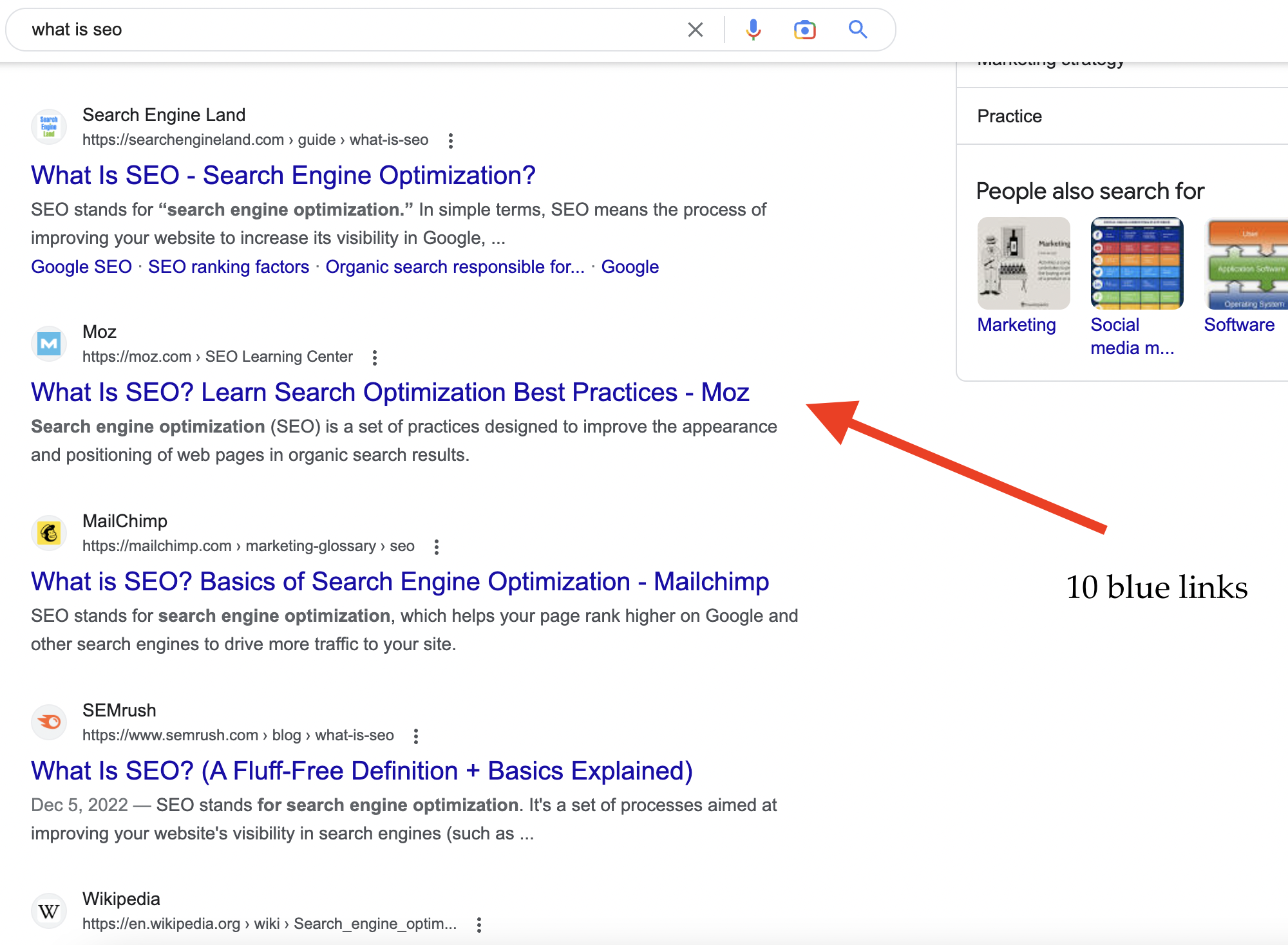
The rules of this era were more complex than Era One, but the core mechanic was legible: rank high on Google, get found. Do not rank high on Google, do not get found. The ten blue links on the first page of results were the new Yellow Pages. Position one was the full-page ad.
Search Engine Optimization emerged as the discipline for navigating these rules. Keywords. Backlinks. Meta tags. Page speed. Mobile optimization. Schema markup. The vocabulary of SEO expanded over 25 years to encompass hundreds of signals, each one reflecting an update to the underlying algorithm.
At its peak, Google processed over 8.5 billion searches per day. The SEO industry it created grew to an estimated $80 billion annually by 2020. An entire professional ecosystem — consultants, agencies, tools, conferences, certifications — was built on one premise: rank high on Google.
The businesses that mastered it captured enormous, durable commercial advantage. Ranking #1 for "best mortgage rates" or "personal injury attorney near me" was worth millions in annual revenue. The businesses that never figured it out watched their customer acquisition costs rise and their visibility collapse.
Era Three lasted 24 years. It was the longest stable era in the history of how businesses get found. Which is exactly why its ending was so disorienting for so many.
| Era | Platform | The Rule | The Metric |
|---|---|---|---|
| Era One | Yellow Pages | Be listed in the right category | Ad size, alphabetical position |
| Era Two | Yahoo / Early Web | Be in the curated index | Directory placement, URL recognition |
| Era Three | Rank high for the right keywords | Position, click-through rate, traffic |
Then, in November 2022, the rules changed again.
Era Four: The Links Disappeared
2022 — 2025 · The ChatGPT Moment
ChatGPT launched to the public on November 30, 2022. It reached one million users in five days. One hundred million in two months. No consumer technology in history had ever grown that fast.
The reason was not novelty. It was utility. People asked questions and got answers — direct, synthesized, immediately useful answers. Not a list of ten links to click through and evaluate. An answer. Done.
The shift was behavioral before it was measurable. People started asking AI models questions they used to type into Google. "What is the best savings account for a small business." "Which personal injury attorneys near me have the best reviews." "Most comfortable walking shoes for wide feet."
The AI model answered. And the answer cited one or two sources — or none at all.
The ten blue links did not disappear overnight. Google still processes billions of queries daily. But the queries that used to end in a Google search increasingly ended in an AI response. The consideration funnel for products, services, and local businesses began to narrow at the top.
If you were not cited in the AI answer, you were not in the consideration set at all.
The businesses that felt this first were the ones in high-intent categories. Financial products. Healthcare. Legal services. Local retail with specific product queries. These are the categories where customers historically relied most heavily on search to make decisions — and where AI models were most confident delivering direct answers.
SEO did not stop working during the transition. But it stopped being sufficient. A business could rank #1 on Google and still be invisible in the AI answer to the same query.
The rules were changing. Most businesses had not noticed yet. The ones that did would be first into Era Five. The new rules were not written yet. Which meant someone could write them.
Era Five: The Goal Is to Be the Source the AI Cites
2025 — Present · The Structured Data Age
Here is the twist ending.
The Yellow Pages was structured data. Every listing followed the same format — name, category, address, phone — so that the directory could be navigated reliably. The structure was the product. Without it, the book was just paper.
Google indexed structured data too. Schema markup. Consistent entity information across platforms. Clear category signals. The businesses that gave Google clean, reliable, structured signals ranked higher than those that did not.
Era Five requires the same thing — structured data — but for a different machine. AI models do not rank websites. They parse entity profiles. They read llms.txt files that tell them how a business wants to be described. They interpret JSON-LD schema that declares what a business is, what it sells, and where it operates. They follow OpenAPI specifications that tell agents what they can do with a business's systems.
The Yellow Pages listed your category, address, and phone. The AI era requires your entity, your product data, your location attributes, and your authority signals — all structured in formats that machines can parse without ambiguity.
Every era has demanded the same thing in a different format: structured, findable, accurate information about your business. The Yellow Pages wanted it in print. Google wanted it in HTML and backlinks. AI models want it in JSON-LD, llms.txt, and entity profiles. The businesses that structure their data for the current era win the current era. The ones that structure it for the last era become invisible.
The new rules are not complicated. But they are different.
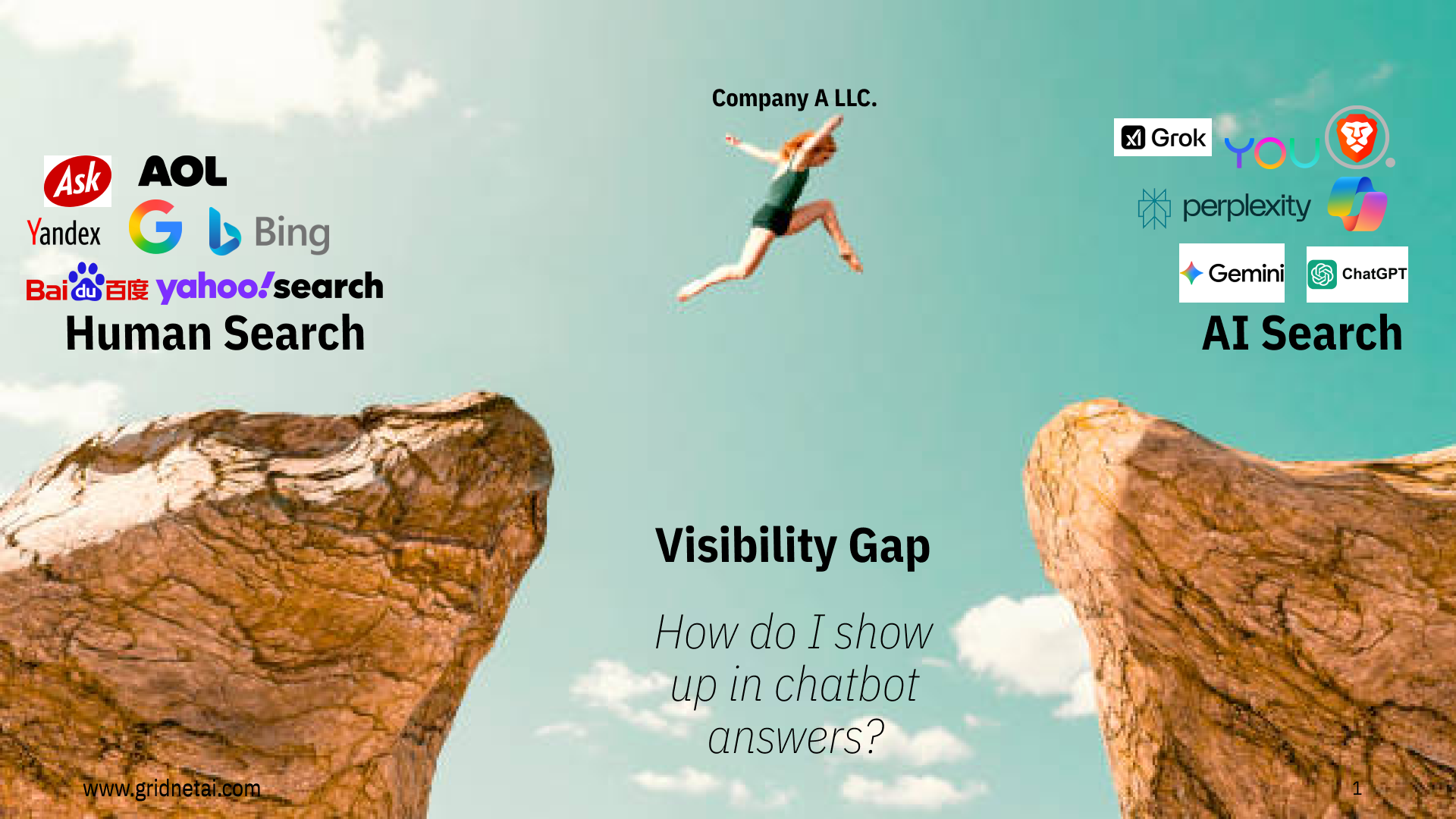
In Era Three, the goal was to rank on page one of Google. In Era Five, the goal is to be the source the AI cites. Not to rank. Not to appear in a list. To be cited — as the authoritative answer to the question a customer is asking right now, in the AI model they opened instead of Google.
That citation is worth more than a first-page ranking. It is worth more than a full-page Yellow Pages ad. It is a direct line from question to answer, with your business as the answer.
The $100 sale. The mortgage application. The appointment booked. The attorney retained. All of it flows from the citation.
The businesses that understand this are building their structured data layer now — before the category hardens, before the infrastructure market has a default platform, before the window closes.
| Era | Platform | The Rule | The Metric |
|---|---|---|---|
| Era One | Yellow Pages | Be listed in the right category | Ad size, alphabetical position |
| Era Two | Yahoo / Early Web | Be in the curated index | Directory placement, URL recognition |
| Era Three | Rank high for the right keywords | Position, click-through rate, traffic | |
| Era Four | ChatGPT / Gemini / Grok | Be mentioned in the AI answer | Citation rate, share of voice |
| Era Five | All AI models | Be the structured entity AI cites as authoritative | Alpha Score, citation authority |
Every era ends the same way: not with a dramatic collapse, but with a slow realization that the rules changed while everyone was busy executing the old playbook.
The Yellow Pages had its moment. Blue links had theirs. AI citations are having theirs right now.
The only question that matters is which era your structured data is built for.
What Era Six Looks Like
We do not know yet. That is the honest answer.
But the pattern is visible enough to make a reasonable prediction.
Every era in this arc was defined by the platform that controlled discovery — the Yellow Pages company, Yahoo, Google, OpenAI. In every era, the platform held the power. Businesses adapted to the platform's rules because they had no other choice. The platform was the gatekeeper.
Era Five is the first era where that gatekeeper relationship is not settled. There is no single AI model. There is no single citation standard. ChatGPT, Gemini, Perplexity, Claude, Grok, Copilot — they each have their own training data, their own weighting logic, their own way of deciding who to cite. The structured data layer that works for one may not work perfectly for another.
That fragmentation will not last. Every prior era consolidated around one dominant platform. Google displaced Yahoo. The smartphone displaced the desktop. Consolidation is the pattern.
Which means Era Six is probably the era when one AI model — or one protocol for structured entity data — becomes the default. The moment a single platform handles the majority of discovery queries the way Google once did, the rules will simplify again. The platform will publish its requirements. Businesses will optimize for them. A new profession will emerge to serve that optimization.
The businesses that are building their structured data layer now are not just winning Era Five. They are building the infrastructure that will carry them into Era Six — whatever form it takes. Clean entity data. Machine-readable profiles. Verified, consistent, structured signals across every platform that will exist between now and then.
The Yellow Pages businesses that built strong brand recognition and clean directory listings in the 1980s had an easier transition to the web. The web businesses that built strong domain authority and clean structured data in the 2000s had an easier transition to Google. The pattern repeats.
The question is not whether there will be an Era Six. There will be.
The question is whether your business will be structured for it — or whether you will spend that era catching up to the businesses that started building in 2025.
Run your Alpha Score at alphapage.ai to see where you stand.
Understand the infrastructure — read What Is GEO? Generative Engine Optimization Explained for the structured data foundation Era Five is built on.
See how it applies to your industry — read The AI Visibility Gap in Financial Services or The AI Visibility Gap in Retail & Ecommerce for vertical-specific applications.
How to Get Cited by AI — v1.0 covers GEO, AEO, and AI Search in full. Get early access at howtogetcitedbyai.com.
This article is a chapter preview.
How to Get Cited by AI — v1.0 is the complete guide to GEO, AEO, and AI Search. Get early access when it drops.
Get Early Access →Get notified when the book drops.